

Most Clicked Products
The Most Clicked Products attribute rewards the products shoppers click most. Clicks are one of the most direct signals of shopper interest: they happen earlier and far more often than purchases, so they respond quickly to changing demand and work well even in collections where sales are too sparse to sort by.
Available for: Collection Sorting (Recipes) and Managed Collections.
How it works
Section titled “How it works”A click is counted when a shopper opens a product from a collection page. Dynasort already tracks these per collection, and you can see them today in the single collection view’s insights.
When this attribute is in a recipe, Dynasort looks at each collection’s own click leaderboard for your chosen timeframe and awards points to the top N products on a sliding scale: the most clicked product gets the attribute’s full point weight, and each rank below it gets proportionally less, down to the last qualifying spot. Products outside the top N earn nothing from this attribute.
Scored per collection, not per recipe
Section titled “Scored per collection, not per recipe”This attribute is unusual: its scores are calculated separately for every collection, even when those collections share the same recipe.
Configuration
Section titled “Configuration”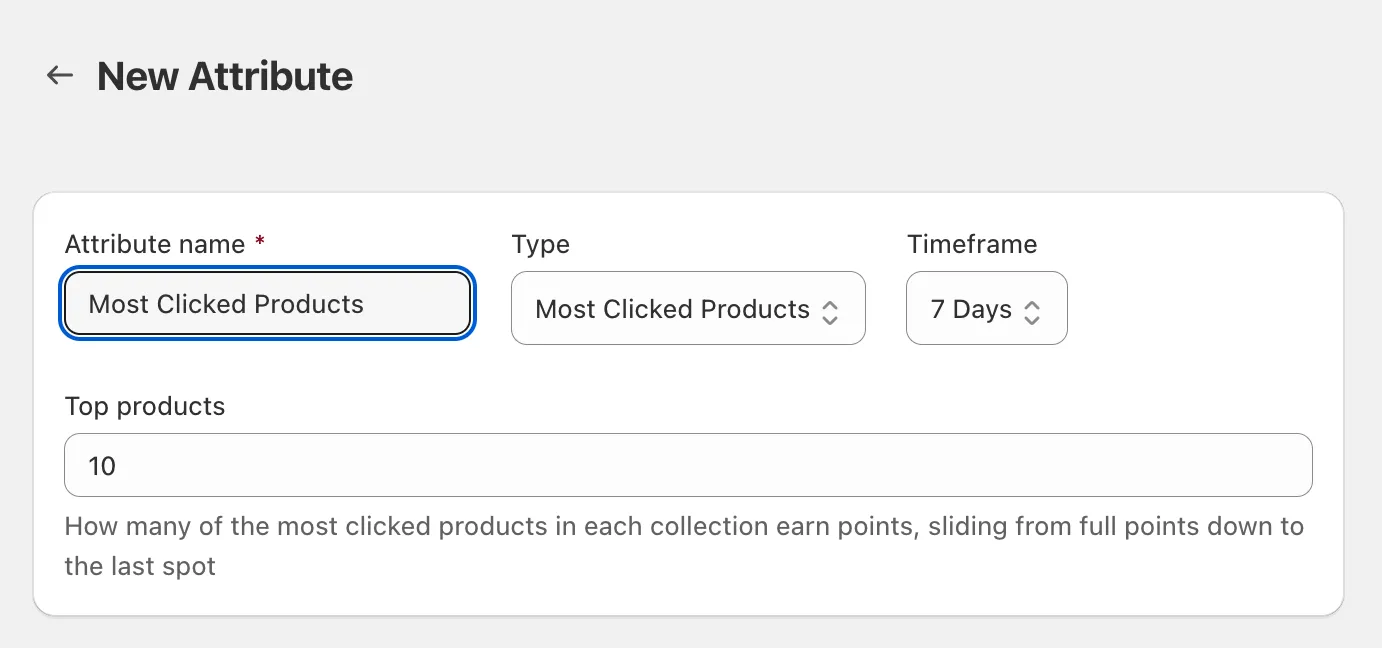
| Setting | What it does | Default |
|---|---|---|
| Timeframe | The click-counting window (24 hours to 90 days) | 30 days |
| Top products | How many of the collection’s most clicked products earn points | 10 |
Methodology
Section titled “Methodology”Points scale by rank position, not by raw click counts. With Top products set to N, the product ranked r earns:
(N - r + 1) / N of the attribute’s point weight
So with the default of 10: 1st place earns 100% of the points, 2nd place 90%, 3rd place 80%, down to 10th place at 10%.
Rank-based scoring is deliberate. Raw click counts vary enormously between collections and stores: a niche collection’s leader might get 40 clicks a month while a flagship collection’s leader gets 4,000. Scoring by rank means the attribute behaves identically in both, with no thresholds to tune per collection. It also keeps one runaway product from flattening the differences among everything below it.
You can see the result in any sorted collection’s product details: the raw value is the product’s clicks in this collection, and the calculated points reflect its rank. Here the collection’s click leader (20 clicks) earns the attribute’s full 10 points:
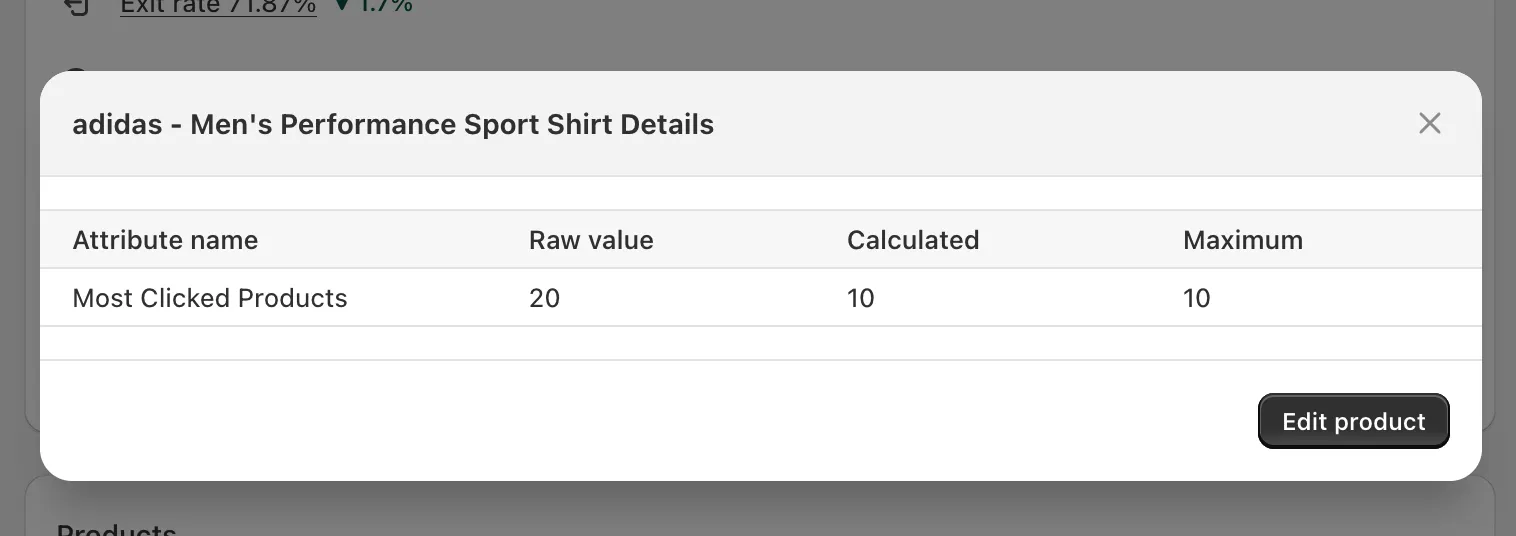
Two products with equal click counts occupy adjacent ranks rather than sharing one, so each step down the leaderboard always costs the same fraction of points.
Using it in a Managed Collection
Section titled “Using it in a Managed Collection”As a managed collection condition, the signal is called Product Clicks and reads as:
Product Clicks [operator] [count] in the last [timeframe]
One important difference: the condition uses a product’s total clicks across your whole store, summed over every collection it appears in. A managed collection is choosing which products to include, so there is no single collection to scope clicks to yet. Use it to build collections like “trending now”: for example, “Product Clicks greater than 50 in the last 7 days.”
Products with no recorded clicks count as zero, so “Product Clicks less than 5” includes products that have never been clicked.
Data freshness and notes
Section titled “Data freshness and notes”- Click data updates periodically throughout the day, not in real time. Expect new clicks to influence sorting within a few hours.
- Brand new collections, and collections with very little traffic, have no click history yet, so every product scores zero on this attribute until shoppers start clicking. Your recipe’s other attributes carry the sorting in the meantime.
- Clicks are counted from your storefront’s collection pages. Product visits arriving from search, ads, or direct links are not collection clicks and do not count here (Product Views covers those).
- Most Clicked Products and Product Views complement each other: views measure overall product interest store-wide, clicks measure what wins attention inside this specific collection.
- A shorter timeframe (7 days) makes the collection track current interest closely; 30+ days favors consistent performers over momentary spikes.
- Keep Top products modest (10 to 20). The goal is to elevate proven attention-getters, not to let click counts dictate the entire collection order.
- Watch for feedback loops: products at the top of a collection naturally get more clicks. Balancing this attribute with merchandising attributes (margin, inventory, newness) keeps the sort from simply reinforcing yesterday’s order.
Frequently asked questions
What does the Most Clicked Products attribute reward?
The products shoppers open most from a collection page. Dynasort ranks each collection's own click leaders for your timeframe and awards points to the top N, with the leader earning the full point weight and each rank below earning proportionally less.
Why is this attribute scored per collection?
Because click leaders differ by audience. Two collections sharing one recipe each promote their own most-clicked products, whereas every other Dynasort attribute scores a product identically everywhere.
How are the points calculated?
By rank, not raw clicks: the product ranked r out of N earns (N minus r plus 1) divided by N of the point weight. With the default top 10, first place earns 100%, second 90%, down to tenth at 10%. Rank-based scoring behaves the same in a niche collection with 40 clicks and a flagship one with 4,000.
How does it work as a managed collection condition?
There it is called Product Clicks and uses a product's total clicks across the whole store, since there is no single collection to scope to yet. 'Product Clicks greater than 50 in the last 7 days' builds a trending collection.
Do clicks from search or ads count?
No. Only clicks from collection pages count here. Product visits from search, ads or direct links are covered by Product Views. Click data updates a few times a day, not in real time.